From 17 to 25 October, Eindhoven transforms into a city of experimentation and new perspectives, where designers present their work to a global audience. Dutch Design Week (DDW) invites designers to set the course of the future. Projects can be submitted by 16 June.
The Full Spectrum
With this Call for Entries we call on the full spectrum of the field—from the speculative to the industrial, the research-driven to the hands-on. Beyond designers, DDW welcomes cultural institutions, brands, and entrepreneurs whose projects are driven by the power of design. We are convinced that design thrives on collaboration; we invite designers, the public and professionals to make that future visible together.
A Global Stage for Design
From early experiments to breakthrough work, DDW provides a platform for every stage of the creative process. Having welcomed names such as Maarten Baas, Studio Drift, and Formafantasma, the week continues to champion the next generation. We converge a wide range of perspectives, presenting urgent, societal, and unexpected ideas to a global audience.
“In a time of social tension, climate crisis and growing inequality, old patterns no longer fit. Sometimes they even hold us back. Design shapes new ways forward. Dutch Design Week is the moment where ideas meet opportunity: a platform for designers, makers and entrepreneurs to show how they shape the future. This call is to help them connect with people who can turn that future into reality.”
Miriam van der Lubbe, Creative Head Dutch Design Week
There is a moment, usually in early spring, when the world tilts back toward color. The first crocus pushes through frozen soil, and suddenly we remember: flowers are not just decoration. They are messengers, medicines, myths, and sometimes—weapons.
Starting March 27, 2026, the Kunsthal Rotterdam invites you to walk inside that idea. Their new exhibition, Flowers Forever, is not a quiet row of botanical prints or a polite tulip retrospective. It is a sprawling, immersive journey through 200 objects pulled from art, design, fashion, and science. For the first time in the Netherlands, this show traces the flower as a living, breathing character in human culture—from ancient altars to Bitcoin-fueled tulips.
Enter the Calyx: A Cathedral of Dried Blooms
Before you read a single wall label, you will be swallowed by Calyx, a massive installation by British artist Rebecca Louise Law. Imagine walking into a room draped with 100,000 dried flowers, sewn together into a single, gravity-defying canopy. The air smells like earth and memory. This is not a space for rushing. It is a deliberate pause—a reminder that flowers, even when dead, still hold time still.
From Myth to Myrtle: Sacred Roots and Greek Echoes
The first chapters of the exhibition go deep—older than oil painting, older than botanical science. Flowers appear in Greek myths (Narcissus staring into his own reflection) and religious traditions as symbols of enlightenment, purity, or paradise. You’ll see paintings and objects that turn petals into prayers. This section asks a quiet question: Why did we first kneel before flowers?
Science’s Secret Garden
Then comes the microscope. Botanical drawings and 18th-century herbaria reveal how closely art and science were once intertwined. But the show does not let history off easily. Artist patricia kaersenhout responds to the famous Metamorphosis insectorum Surinamensium by Maria Sibylla Merian (1705) with her own vibrant tapestries, Of Palimpsests and Erasure. Kaersenhout reminds us that Merian’s groundbreaking knowledge of Surinamese plants and insects came largely from enslaved local and African women—their names mostly erased. In this gallery, a flower becomes a quiet accusation.
Tulip Mania, Rebooted with Bitcoin
We all know the story: in 17th-century Holland, a single tulip bulb sold for more than a craftsman’s annual wage. Flowers Forever gives us that history, then twists it. British artist Anna Ridler offers Mosaic Virus (2019)—a video triptych where a tulip’s growth is tied directly to the fluctuating price of Bitcoin. As the cryptocurrency rises and crashes, the flower blooms and falters. It is strange, beautiful, and deeply unsettling. Is a tulip still just a tulip when it trades like a stock?
The Politics of Petals
Flowers have also been flags. The exhibition includes political cartoons and protest posters where a rose or a poppy stands for revolution or resistance. But the most powerful work here may be Kapwani Kiwanga’sThe Marias. In a luminous yellow room, she presents two paper cutouts of the peacock flower. Its seeds were carried in the hair of enslaved African women—hidden, but potent. The plant could induce abortion, offering a last form of agency and survival. Meanwhile, Victorian women folded paper flowers as a “harmless” pastime. Kiwanga places these two truths side by side. You leave the room changed.
When Flowers Learn to Move
Not everything is heavy. The Dutch duo Studio DRIFT presents Meadow—an inverted landscape of mechanical flowers that open and close in slow, breathing rhythms. They are not alive, but they mimic life so tenderly that you might forget. And Miguel Chevalier’sExtra Natural is a fully digital, interactive garden where seeds sprout at your feet as you walk. It is playful, futuristic, and oddly soothing.
Why You Should Go
Flowers Forever is not a show about looking at pretty things. It is about why we need them—for ritual, for profit, for science, for survival. You will leave with more than a catalog in your bag. You will notice the dandelion cracking through a sidewalk crack differently. You might even see the cut flowers on your kitchen table as small, silent histories.
Practical info: 📅 *27 March – 30 August 2026* 📍 Kunsthal Rotterdam, Museumpark 🎟️ Combine your visit with a Spido harbour cruise for a full Rotterdam spring day.
All images and details courtesy of Kunsthal Rotterdam. The exhibition is co-produced with Kunsthalle München.
From a reflection on humans to matter as meaning: the new Salone communication campaign explores the physical and symbolic origins of design, a visual narration made up of different perspectives, united by a common idea of transformation and genesis
Following the 2025 human-centric campaign Thought for Humans devised by the sensitive, documentarist American photographer Bill Durgin, the Salone del Mobile.Milano is continuing its process of reflection on the meaning of design with A Matter of Salone, the communication campaign for the 2026 edition. While design was explored last year as a language in the service of people, the starting point for this year is even more original: matter. Matter that can be touched, read and interpreted. Matter that preserves memory while also concealing as-yet undiscovered potential.
The campaign is taking shape around an essential question: what meaning can design take on today? The answer, both visual and conceptual, has its roots in matter, understood not only as a physical substance, but as an origin, a memory, a possibility to be activated. It is no longer just a question of form or function: it is a process by which what is tangible is transformed into value. Matter, in fact, is matter, but also what matters, what generates meaning.
This ambivalence is what forms the basis for A Matter of Salone, a collective project by Motel409 involving six contemporary creative figures: the photographers Charles Negre, Eduard Sánchez Ribot and Alecio Ferrari, and the set designers Studio Végété, Laura Doardo and Stilema Studio. The project has generated a stratified system of images, built by several different hands, in which each intervention amplifies the common vision. The approach was deliberately multidisciplinary, in a bid to convey the complexity of the initial idea through a language made up of matter, light, gesture and transformation. The result is imagery that channels both concreteness and abstraction, a visual composition capable of evoking as well as explaining, deeply connected to the culture of design.
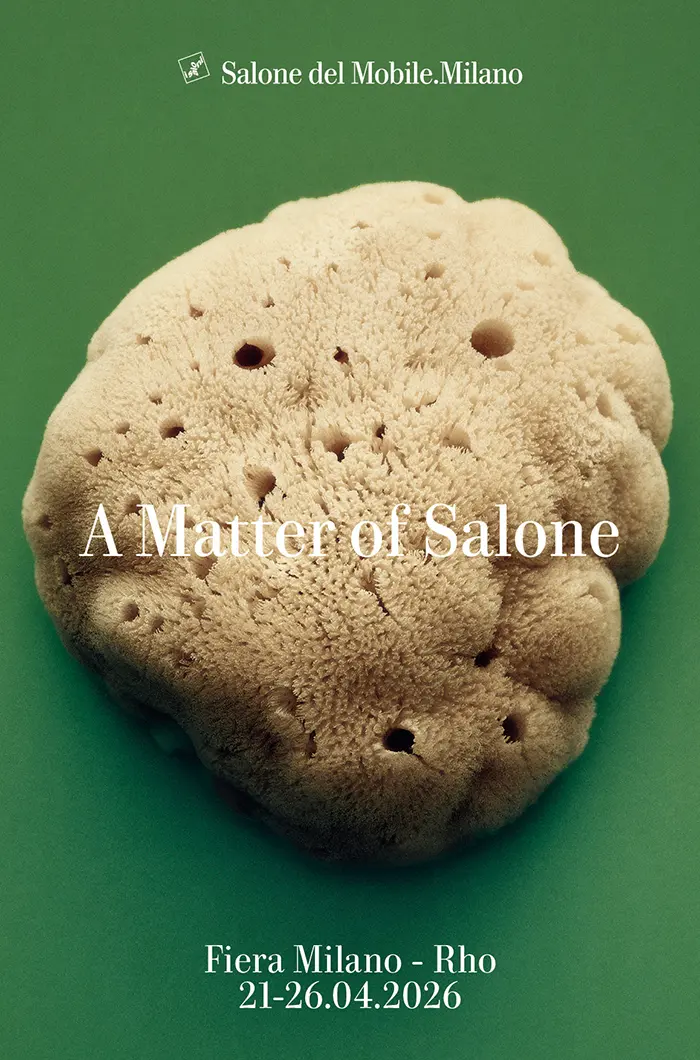
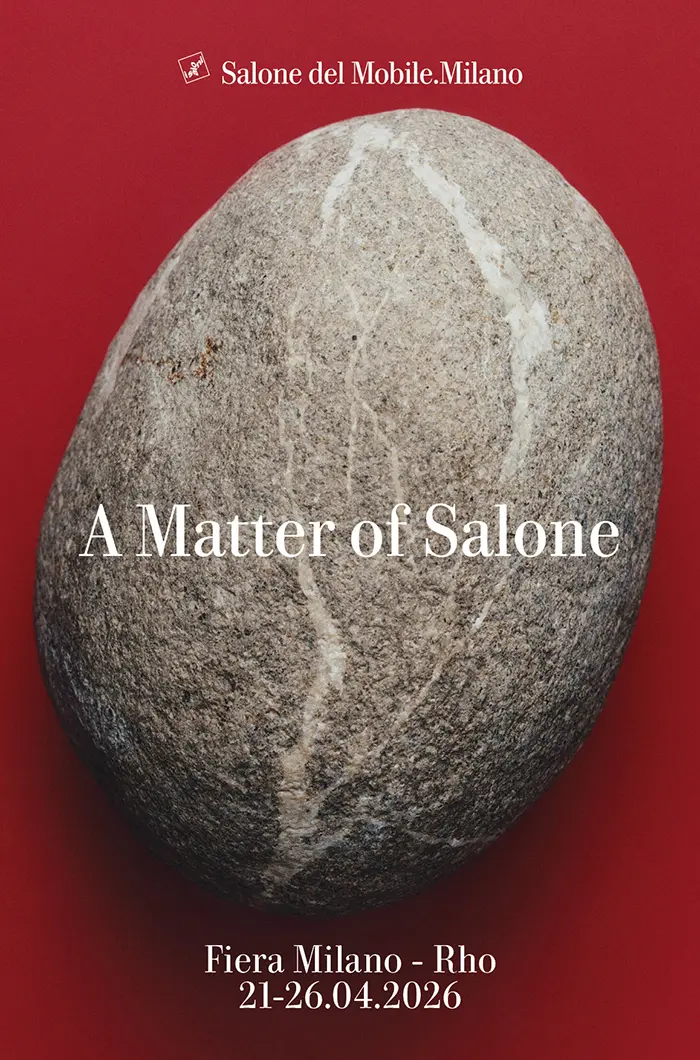
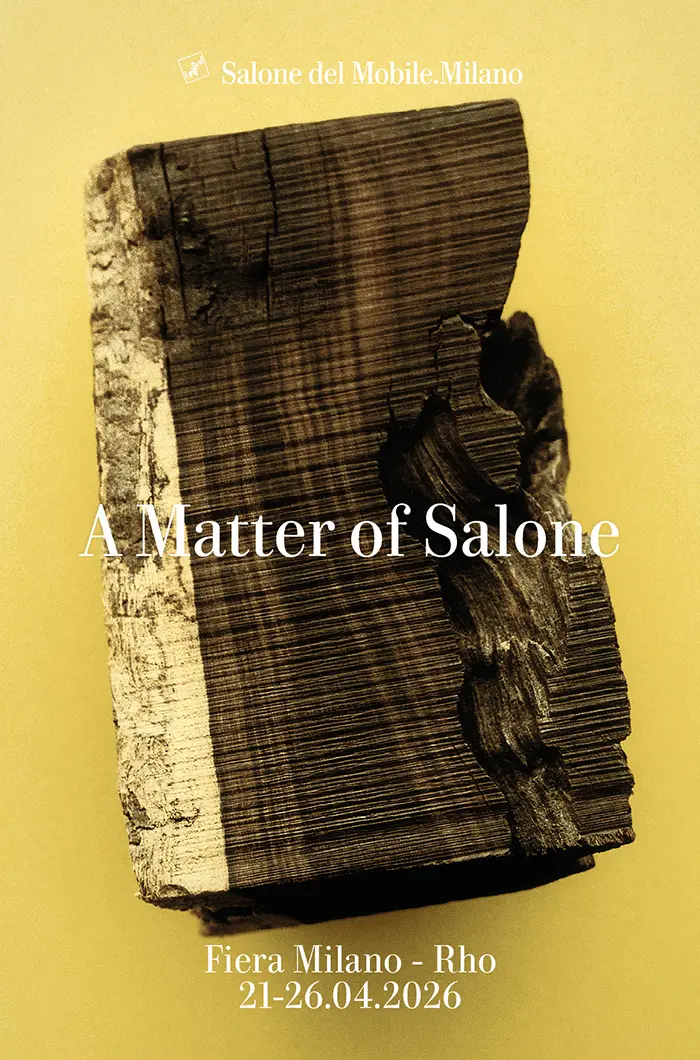
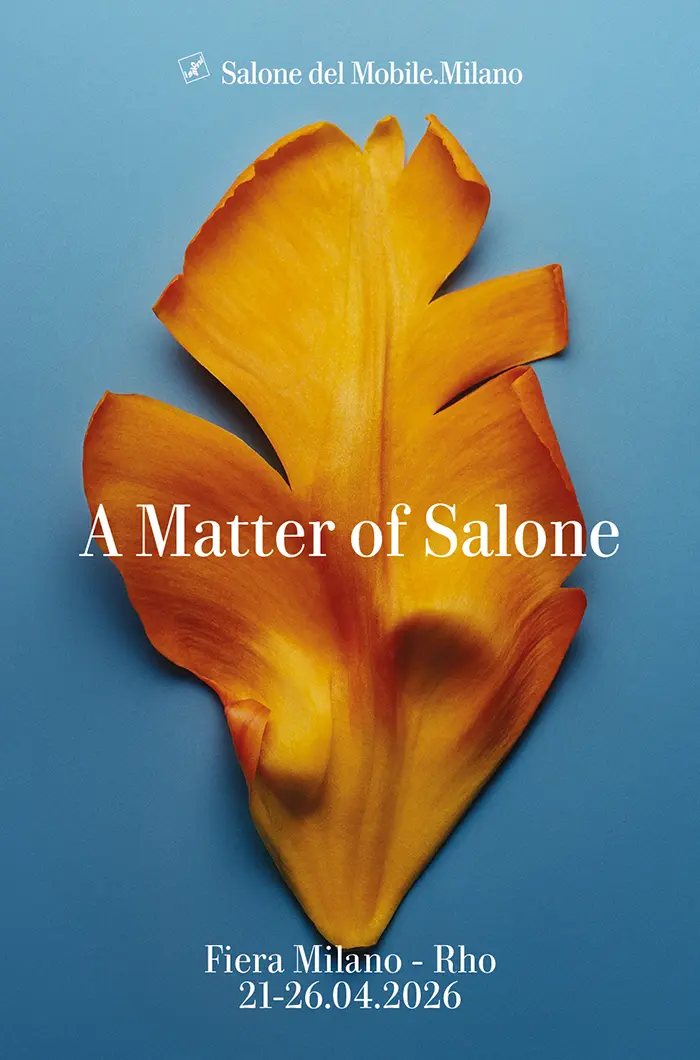
Communication Campaign Salone del Mobile.Milano 2026 “A Matter of Salone”: Sponge @Charles Negre Studio Végété, Set-designer Concept Motel409Communication Campaign Salone del Mobile.Milano 2026 “A Matter of Salone”: Stone @Eduard Sánchez Ribot Laura Doardo, Set-designer Concept Motel409Communication Campaign Salone del Mobile.Milano 2026 “A Matter of Salone”: Wood @Eduard Sánchez Ribot Laura Doardo, Set-designer Concept Motel409Communication Campaign Salone del Mobile.Milano 2026 “A Matter of Salone”: Petal @Charles Negre Studio Végété, Set-designer Concept Motel409
The campaign revolves around material objects, each of which represents a fundamental design principle. Stone represents origin, a symbol of simplicity devoid of frills; excavated, deconstructed, and covered, it becomes a challenging ground for new perceptions of solidity. The petal embodies the sensuality of matter, enhanced by techniques such as laser cutting and ink dye, which highlight the most cutting edge possibilities of material innovation. Wood, a living material, tells the story of function: it is a sign of continuity between man, nature and construction, revealing its expressive potential through drilling, joints and sculptures. Sponge, with its changing volumentry, speaks for reinvention: a changing material, allowing itself to be folded, compressed, and emerge from the shadows to become a visual icon.
As Federico Grassi, Creative Director of Motel409, says: “We asked ourselves what happens to matter when seen through the lens of design. This question informs A Matter of Salone: a work by several different hands, in which the energy of the materials blends with the vision, the gesture, the image. We didn’t want to illustrate design, but to evoke it. To experience it visually and sensorially, letting the material itself tell the story – and the Salone was, as always, the space in which this transformation could take place.”
The narrative structure of the campaign has been devised as a three-act process. It begins with a close-up exploration of the material, in shots that reveal its skin, its texture, its essence. We then move on to the presentation of the objects in their archetypal, essential form. Finally, the material allows itself to be subjected to the human gesture: to be touched, sculpted and altered, in a visual sequence that culminates in hands, tools and materials that come together and dialogue. The result is a visual and symbolic crescendo, culminating in the revelation of the finished artefact: objects that carry with them not only function and form, but also memory, tension, vision.
A Matter of Salone is a great deal more than just a visual project. It is an act of listening and translation. An invitation to see design not just as a discipline, but as an embodied thought, capable of crisscrossing materials and meanings, of restoring depth to the act of designing. Here matter is no longer just a resource or a surface: it is a voice, a story, a horizon to be imagined together.